
Part 3:
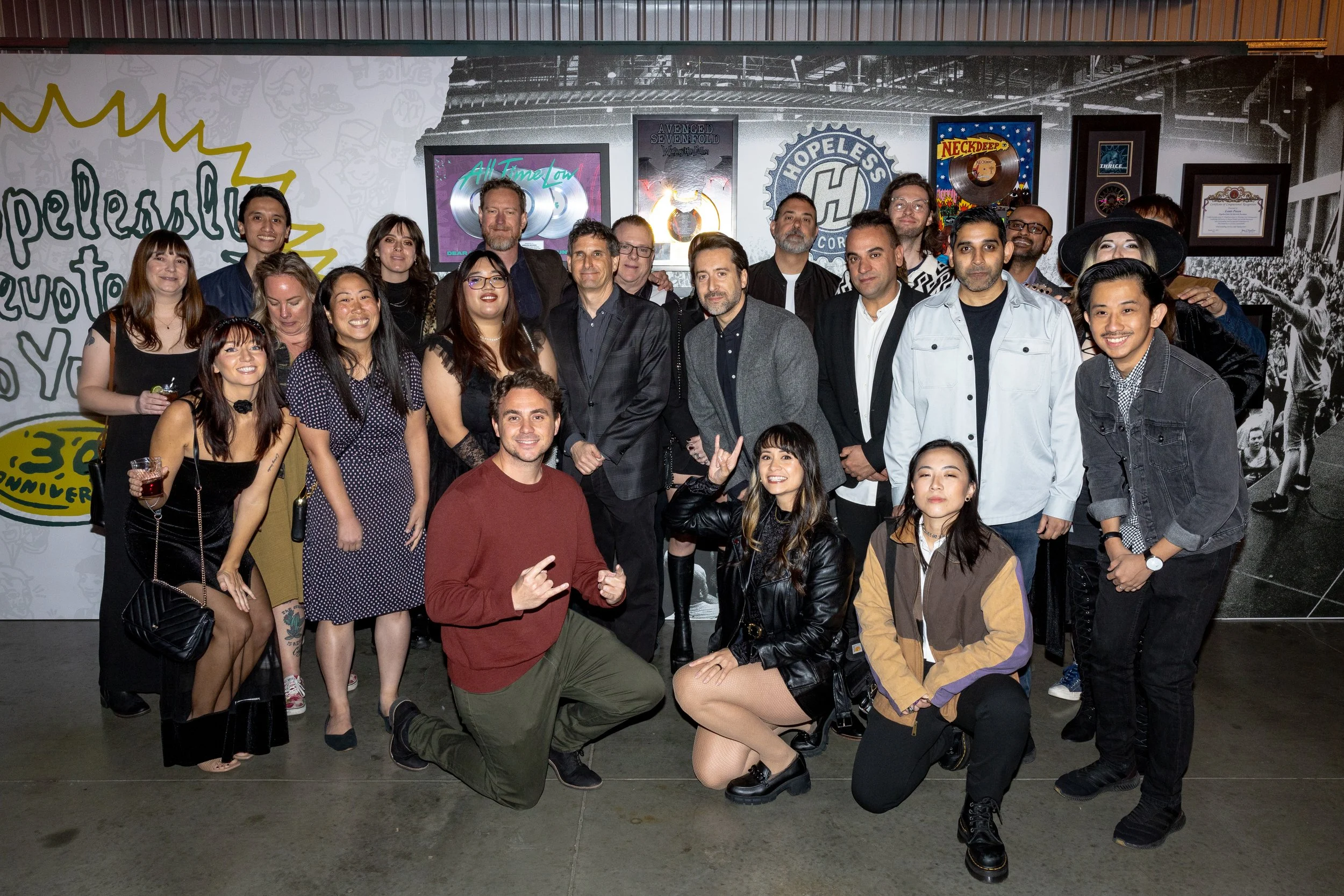
Hopeless Records team

Workforce and Inclusion
Key Takeaways
-
The survey did not include any more specific data on racial, LGBTQI+ and gender or other defined characteristics. We recognize the need for this data to be collected, but were unable to in this study.


Working Conditions
Khruangbin
Employee Benefits & Training
The results of our analysis indicate that the labels surveyed provide supportive working conditions for their staff, reflecting a recognition that the best results emerge from treating staff with the same respect and long‑term care that the labels show for their artists.
As noted in the ORCA Setting the Stage report, independent record labels are known for the length of tenure of their teams. According to the Worldwide Independent Network (WIN), 42% of staff at independent music companies have been there since founding, a particularly striking figure given that the average label is nearly 15 years old. [27]
The data from our survey further supports this picture. A significant majority of label workers, 83%, are formal employees who receive the full benefits of that status, including job security, health insurance, and pension contributions.[28] In an industry often characterized by part‑time, contract‑based, and precarious work, this signals a strong commitment by independent labels to providing stable, equitable employment.[29]
83% of participating labels’ workforce is made up of formal employees, who receive all the benefits of this status, including job security, health insurance, and pension contributions.
In addition to financial and contractual stability, the data also highlights meaningful investment in staff development and wellbeing. 52% of workers at participating labels receive role‑specific training, with three labels providing this support to their entire workforce.[30] This kind of training is essential in the constantly evolving music industry, where technologies like AI, web3, and new digital platforms are rapidly changing how music is created, distributed, and monetized. It allows staff to upskill and build the expertise needed to support artists effectively through this shifting landscape, while also feeling confident and empowered in their own career development.
-
Data via WIN. See: https://winformusic.org/mp-files/wintel-2018.pdf/
-
The analysis of ‘formal employment’ only includes results from eight of the labels in the sample – Alligator Records (via Exceleration Music), Domino Recording Co., Hopeless Records, Partisan Records, Playground Music, Secret City Records, Secretly Group, XL Recordings Limited (via Beggars Group).
-
A significant body of research shows that arts and culture workers, including those in the music industry, are more likely to be informally employed, self‑employed, or working part-time compared to the general workforce. See, for e.g.: Culture Action Europe (2024); Bain (2024); European Labour Authority (2024); Urban Institute (2021); Gross and Musgrave (2020); Cloonan and Williamson (2023).
-
The analysis of ‘role-specific technical and professional training’ only includes results from 8 of the labels in the sample: Domino Recording Co., Hopeless Records, Ninja Tune, Partisan Records, Playground Music, Secret City Records, Secretly Group, XL Recordings Limited (via Beggars Group)
“Two things I say often are: ‘if I do my job correctly, I am putting myself out of a job’ and ‘I only hire people who can do the job better than I can.’ I need to work with brilliant, smart people that I'm learning from constantly and the company evolves by building around them.”
Tim Putnam, Co‑founder and President at Partisan Records.
Furthermore, 54% of workers at participating labels receive wellbeing and mental health training, with four labels offering it universally. This has become an increasingly important resource as labels work to support their teams in managing the pressures of a fast‑paced, constantly evolving industry. Nonetheless, work‑life balance remains a concern, with 23% of staff reporting that they work extra hours, suggesting that ongoing attention is needed to ensure sustainable workloads. These findings are especially relevant given broader research showing that those working in the music industry, across both creative and non‑creative roles, experience significantly higher rates of mental health challenges than the general population. In this context, investments in mental health training and wellbeing support are not only timely, but vital to creating healthier, more resilient workplaces within the music industry.
The ethos of investing in people demonstrated above is echoed by Tim Putnam of Partisan Records, who emphasizes the importance of treating the entire label team as indispensable and valuing staff not just through compensation, but by building a workplace rooted in mutual respect and learning: “I believe a good company has to compensate everybody that is there accordingly. We evolve in that way as a company, with better business practices that are founded in the reasons as to why we’re doing this as a company… If I do my job correctly, I am putting myself out of a job. I need to work with brilliant, smart people that I’m learning from constantly and the company evolves by building around them.”
54% of workers at participating labels receive wellbeing and mental health training, with four labels offering it universally.
Employee Profit Sharing

Wednesday
Our analysis also shows that a number of independent labels are adopting formal profit‑sharing mechanisms, to ensure that employees directly benefit from the company’s financial success. On average, 8% of annual profits across the participating labels are distributed to employees. While the overall share may appear modest, it reflects a growing commitment to more inclusive and participatory business practices within the independent sector.[31][32]
-
The analysis of ‘employee profit sharing’ only includes results from eight of the labels in the sample – Alligator Records (via Exceleration Music), Domino Recording Co., Hopeless Records, Partisan Records, Playground Music, Secret City Records, Secretly Group, XL Recordings Limited (via Beggars Group).
-
Hopeless Records, for example, has implemented a dual-structure profit-sharing model. The first component is company-wide and integrated into its 401(k) safe harbor plan, which includes both guaranteed contributions to employee retirement funds, as well as additional discretionary profit-sharing based on the label’s annual performance. In addition, Hopeless uses a lesser known mechanism called a “phantom stock plan” for its senior executives, which simulates equity ownership by offering a share in both annual dividends and any future sale of the company.
Local Employment Impacts
Independent record labels also function as meaningful economic anchors within their communities. Our analysis shows that 60% of employees at participating labels reside in the same city where the label is taxable, representing 433 individuals across the nine labels directly contributing to their local economies, through taxes and induced economic impacts, as they live and spend in their communities. This figure reflects independent labels’ longstanding connection to their local communities, where hiring often prioritizes people embedded in the local music scene. As Justin West of Secret City Records puts it, these are people who are “passionate about music” and already part of a label’s cultural orbit.
A breakdown of job categories (see figure below) reveals that local resident employment is particularly concentrated in executive, operational, and administrative roles within the participating labels. For example, 93% of staff working in Executive and Senior Management are local residents, as are high percentages in Finance and Administration (93%), Technology and IT Support (88%), Business and Legal Affairs (81%), Other Roles (84%), Human Resources (67%), and Marketing, Sales, and Distribution (66%). This suggests that independent labels are not only employing local residents in leadership roles but also building stable career pathways in key business areas such as finance, marketing, and technology.
Local Resident Workers (%)
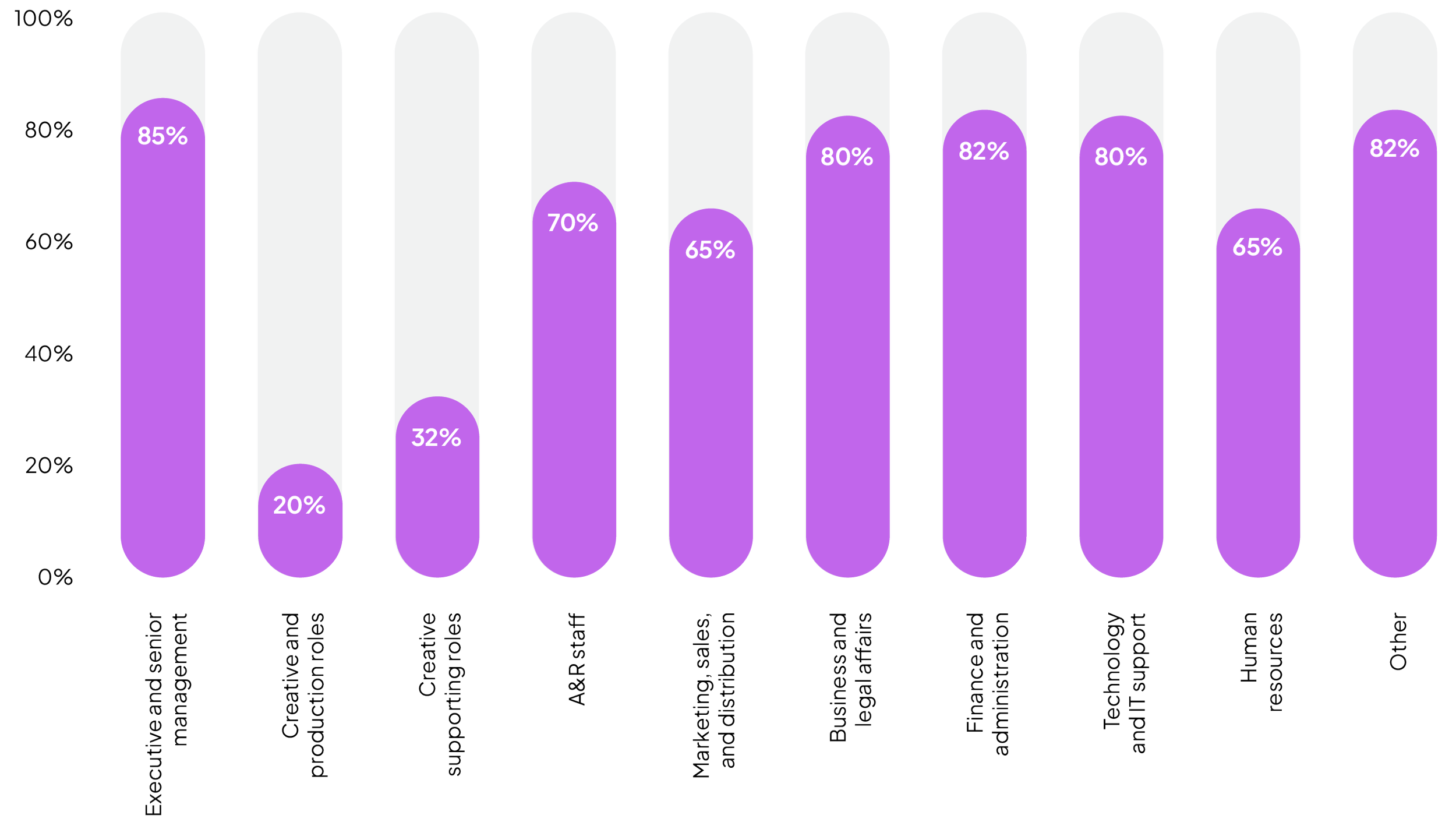
60% of employees at participating labels reside in the same city where the label is taxable and contribute directly to their local economies through taxes and induced economic impacts, as they live and spend in their communities.
On creative side roles, the picture is more mixed. Only 19% of Creative and Production roles and 31% of Creative Supporting roles at the labels are held by local residents. However, this is not surprising given the increasingly remote, project‑based, and geographically fluid nature of creative work in the global music industry. Decisions around who fills these roles are also often driven by artists themselves, who typically choose to work with specific producers, engineers, or creative collaborators with whom they have existing relationships or creative chemistry, regardless of location.
Gender Diversity & Inclusion
Nubiyan Twist
Employee Gender Diversity
The results of our analysis indicate that women make up 46.6% of total workers across the participating labels, and hold 31.5% of all executive and senior management roles. When put in context with recent industry benchmarks these figures suggest that the labels in our study are meeting and in some cases outperforming broader industry averages when it comes to gender inclusion, particularly in leadership.
For example, USC Annenberg’s 2025 Inclusion in the Music Business report shows that only 13.2% of top executives across 37 leading music companies are women.[33] In contrast, women’s representation in senior roles at the labels in our study is more than twice that figure, highlighting the independent sector’s progress on gender equity at the leadership level.
Other industry benchmarks present a more complex picture. UK Music’s 2024 Diversity Report cites a higher figure of 48.3% of ‘senior’ roles held by women in the UK music industry, which exceeds the 31.5% in our sample. However, these findings should be interpreted with care, as the report is based on a voluntary, self‑selecting survey limited to the UK. As UK Music itself notes, the data “should be seen as a way to highlight broad trends in the industry… Some caution must be taken when interpreting the figures, as we are ultimately constrained by who decides to fill it in.”
Women make up 46.6% of total workers across the participating labels, and hold 31.5% of all executive and senior management roles.
With this in mind, our results still point to meaningful progress among participating labels, particularly as our data is drawn from actual employment records rather than self‑reported surveys. The findings suggest that independent labels are well‑positioned to lead on gender equity, but also highlight the need for continued action to close remaining gaps and address persistent structural inequalities across the broader industry.
A closer look at department-level data in our analysis shows (see figure below) that gender representation varies among participating labels. Women are well‑represented in departments such as Business and Legal Affairs (61%), Marketing, Sales, and Distribution (56%), A&R (50%), Human Resources (50%), and Other roles (52%).
Directly Hired Women, by Department (%)

Encouragingly, several labels also indicated that they are taking proactive steps to embed equity and inclusion more deeply into their organizational cultures. 73% of workers across the participating labels receive diversity training, aimed at increasing awareness of equity, diversity, and inclusion principles. Five labels confirmed that they provide this training to all employees. These figures demonstrate a commitment from the labels to equipping staff with the knowledge and tools needed to foster more inclusive workplaces.
The importance of such training is underscored by broader industry research. For instance, the Independent Society of Musicians’ (ISM) Dignity at Work series has documented widespread discrimination in the UK music sector, with 66% of respondents to their sectoral survey reporting personal experience of discrimination, of which 78% was directed at women. The reports emphasize the need for training not just as education, but as a first step toward organizational change and accountability.[34]
Mentorship and representation are also critical in creating more inclusive environments. One promising example of how the independent music sector as a whole is addressing gender disparities in the music industry is Merlin Engage, a mentorship program designed to support the career development of women in independent music, which includes participation from several labels included in our study. Now in its third year, the six‑month program pairs emerging professionals with senior executives from leading independent music companies. Through one‑on‑one mentoring, skill‑building workshops, and an active alumni community, the program helps ensure more diverse representation in music industry leadership, and represents an essential step in reducing the conditions that allow discrimination to persist. The program was initiated by Marie Clausen, Managing Director for North America at Ninja Tune. “When I initiated the Merlin Engage mentorship programme, I had a strong vision of empowering the next generation of leaders,” Clausen explains. Reflecting on her own career path, she notes, “I received valuable mentoring that made me recognise the power within our community to change things for the better.”
However, disparities persist in others: Creative and Production roles include only 18% women, Technology and IT support just 6%, and Finance and Administration 39%. While some departments are approaching gender parity, these gaps highlight the need for targeted efforts to improve female representation throughout independent record labels. In particular, there is a clear need to focus recruitment, mentorship, and advancement opportunities in areas like technology, production, and finance, which have traditionally seen lower female participation but are critical to shaping the future of the music industry.
73% of workers across the participating labels receive diversity training, aimed at increasing awareness of equity, diversity, and inclusion principles.
-
In another analysis with an expanded sample of 77 music companies, the Annenberg study found that only 15.6% of CEO/President roles across the sample are held by women.
-
After providing free equity, diversity and inclusion training for five years, IMPALA launched a pilot toolkit in September 2025 to help their members track progress and access training. The tool is co-funded by the EU and will suggest future improvements at a company level as well as contribute to an anonymous sector survey. Specifically designed for independent music companies, the aim is to help adopt a sector approach, in a similar way to the framework IMPALA has introduced for carbon accounting through a free calculator tool.

Frankie Cosmos
Artist Gender Diversity
The results of our analysis indicate that 23.06% of active artists in 2023 across the participating labels were either solo female artists or all‑female groups, while 18.71% of artistic projects involve collaborations between male and female artists.[35] Combined, this means that females are represented in 41.8% of the artist pool, whether as solo artists or as contributors to collaborative projects. While there is room for growth in the number of female‑led projects, the strong presence of women in collaborative work signals encouraging progress toward broader gender inclusion across independent label rosters.
This progress is also reflected in broader market trends. According to the USC Annenberg Inclusion Initiative’s 2023 report Inclusion in the Recording Studio?, 40.6% of artists featured on the Billboard Hot 100 Year‑End Chart were women. The comparable levels of overall representation in our study suggest that independent labels are helping to push industry norms forward, particularly through artist development approaches that create space for a range of voices.
At the same time, the relatively lower percentage of women in solo or primary roles highlights an opportunity for further investment in women‑led projects. As independent labels continue to emphasize values of equity and community, intentional strategies to support and elevate women artists can build on this momentum. With their deep involvement in artist development and close artist relationships, independent labels are well‑positioned to lead in shaping a more inclusive future for music creation and representation.
Women were represented in 41.8% of artist projects across participating labels in 2023
23.1% of active artists were women
18.7% of projects featured mixed‑gender collaborations
-
The analysis of ‘artist gender diversity’ only includes results from 8 of the labels in the sample: Alligator Records (via Exceleration Music), Domino Recording Co., Hopeless Records, Ninja Tune, Partisan Records, Playground Music, Secret City Records, and XL Recordings Limited (via Beggars Group).